
An aerogel blanket is not simply “aerogel powder glued onto a fabric.” Behind every roll sits a controlled chemical process — the sol–gel route — in which a liquid silica sol is combined with a fiber felt, transformed into a wet gel, made water-repellent, and then dried in a way that preserves the aerogel’s nanoporous structure. This page walks through the aerogel blanket production process step by step, exactly as it runs on a modern production line.
Two Production Routes: Belt Coating and Immersion
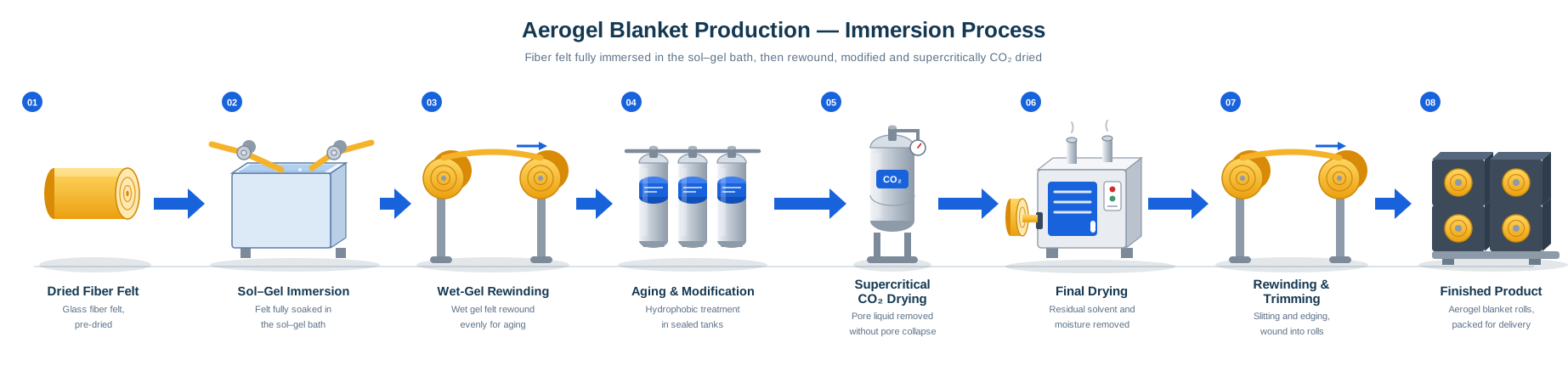
Manufacturers use two main ways to bring the sol into the fiber felt. In the belt-coating process, the felt moves continuously along a conveyor while the sol is metered onto its surface and allowed to gel in place. In the immersion process, the felt passes through a bath and is fully soaked in the sol, then rewound for gelation and aging. Both routes converge at the same critical finishing stage: supercritical CO₂ drying.

The Process, Step by Step
1. Raw Materials: Fiber Felt and Silica Sol
The carrier is a needled fiber felt — most commonly glass fiber, and for higher-temperature grades, ceramic or pre-oxidized fiber. The aerogel precursor is a silica sol, typically prepared from a silicon alkoxide such as TEOS, mixed with a solvent and a catalyst. Felt is pre-dried before use, because residual moisture would disturb gelation later.
2. Sol–Gel Impregnation
The sol must penetrate the felt evenly; dry pockets become weak spots in the finished blanket. Belt coating meters the sol onto the moving felt, while immersion soaks the felt completely in a bath with guide rollers. Timing matters here — once the catalyst is added, the sol starts its journey toward gelation, so impregnation and gelation are tuned as one continuous operation.
3. Gelation
Inside the felt, the sol turns into a wet gel: a three-dimensional silica network filled with liquid. This network is the skeleton of the final aerogel. Gelation time and temperature are controlled tightly, because they decide the pore structure — and the pore structure decides the thermal conductivity.
4. Aging and Hydrophobic Modification
The wet gel rests in sealed tanks to strengthen its network. It is then treated with a hydrophobic agent that caps the surface silanol groups. This is what makes a quality aerogel blanket water-repellent instead of moisture-absorbing — a property that matters for decades of service on pipelines and building envelopes.
5. Supercritical CO₂ Drying
This is the step that separates true aerogel from lookalikes. If the pore liquid were simply evaporated, surface tension would collapse the nanopores. Instead, the liquid is exchanged for liquid CO₂, which is then taken above its critical point (31.1 °C, 73.8 bar) and vented as a gas. With no liquid–vapor interface, there is no capillary force — the pores survive, and the blanket keeps its ultra-low thermal conductivity.
6. Final Drying, Rewinding and Trimming
A final oven pass removes residual solvent and moisture. The blanket is then rewound, slit to width, edged, and wound into rolls of standard lengths — ready for packing and delivery.
Why Supercritical Drying Matters to Buyers
Some low-cost “aerogel” products are dried at ambient pressure. The result is technically a xerogel: denser, with higher thermal conductivity and weaker hydrophobicity. When you evaluate a supplier, ask one question — is the blanket supercritically dried? The answer tells you more about long-term performance than any datasheet headline. You can explore blankets produced with the sol–gel route in our aerogel blanket range.
Belt Coating vs. Immersion: A Quick Comparison
| Belt Coating | Immersion | |
|---|---|---|
| Sol application | Metered onto felt on a moving belt | Felt fully soaked in a sol–gel bath |
| Line style | Continuous, inline gelation | Batch-oriented, rewound for aging |
| Best suited for | Steady large-volume runs | Thicker felts, deep penetration |
| Shared core steps | Aging, hydrophobic modification, supercritical CO₂ drying, final drying | |
FAQ
How are aerogel blankets made?
By the sol–gel process: a fiber felt is impregnated with silica sol, gelled, aged, made hydrophobic, and then dried with supercritical CO₂ so the nanoporous structure survives. The two common impregnation routes are belt coating and immersion.
What is supercritical drying in aerogel production?
A drying method where the pore liquid is replaced by CO₂ taken above its critical point, so the liquid turns to gas without a phase boundary. Capillary forces never appear, and the aerogel’s pores do not collapse.
Is every aerogel blanket supercritically dried?
No. Ambient-pressure-dried products (xerogels) exist and are cheaper, but they are denser and conduct more heat. Always confirm the drying route when comparing suppliers.
For the science story behind aerogel, see how aerogel was invented. Choosing a product? See our AG65 aerogel blanket for building insulation or the AG65 Plus for service up to 650 °C.
 English
 Chinese (China)
 Portuguese
 Spanish
 French
 Italian
 Turkish
 Vietnamese
 German
 Japanese
 Korean
 Hindi
 Arabic
 Polish
 Chinese (Taiwan)
 Malay
 Thai
 Finnish
 Dutch
 Swedish
 Slovenian