
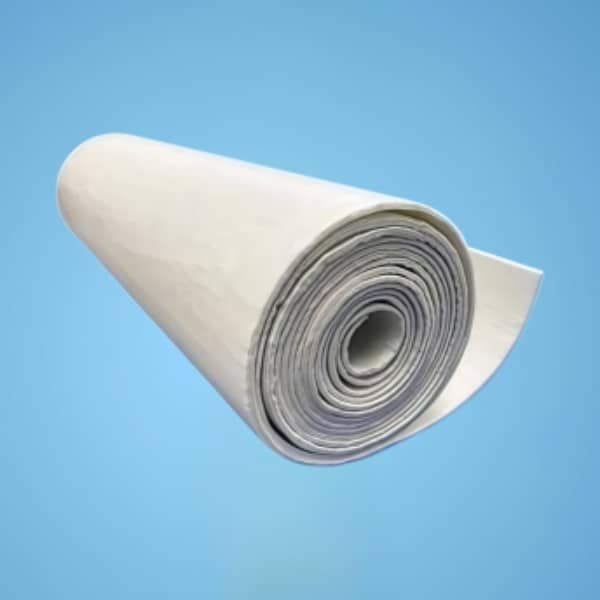
Special Fiberglass Aerogel Blanket (AG90)
Product Description
The Special Fiberglass Aerogel Blanket (AG90) is a high-performance thermal insulation composite material reinforced with High-performance Glass Fiber Mat and integrated with silica aerogel. It is manufactured through advanced processes such as sol-gel technology and supercritical drying.
The product features outstanding thermal insulation performance, excellent hydrophobicity, Class A fire resistance rating, non-toxicity, environmental friendliness, and long service life.
It is widely used for thermal insulation in petrochemical pipelines, district heating pipelines, storage tanks, armored vehicles, modular shelters, new energy batteries, and energy-efficient buildings.
Working Principle
Silica aerogel features a continuous and irregular nanoporous network structure. Both the colloidal particles and the pore structures are on the nanometer scale. The particles are interconnected by Si–O–Si chemical bonds, forming a three-dimensional network skeleton, while the pores are filled with gaseous dispersing media.
This unique nanostructure—composed of nanopores and nanocolloidal particles—creates multiple thermal resistance mechanisms, including the multi-barrier effect, the nano-skeleton heat resistance effect, and the near-zero convection effect. These mechanisms effectively reduce and block heat transfer.
By incorporating inorganic High-performance Glass Fiber Mats into the aerogel, the mechanical strength and processability of the material are significantly enhanced. As a result, the composite material maintains an extremely low thermal conductivity while also achieving adequate mechanical strength.
Working Principle
Silica aerogel features a continuous and irregular nanoporous network structure. Both the colloidal particles and the pore structures are on the nanometer scale. The particles are interconnected by Si–O–Si chemical bonds, forming a three-dimensional network skeleton, while the pores are filled with gaseous dispersing media.
This unique nanostructure—composed of nanopores and nanocolloidal particles—creates multiple thermal resistance mechanisms, including the multi-barrier effect, the nano-skeleton heat resistance effect, and the near-zero convection effect. These mechanisms effectively reduce and block heat transfer.
By incorporating inorganic High-performance Glass Fiber Mats into the aerogel, the mechanical strength and processability of the material are significantly enhanced. As a result, the composite material maintains an extremely low thermal conductivity while also achieving adequate mechanical strength.
Product Specifications and Model
Model No. | Thickness/mm | Width/mm |
AG90 | 3/6/10(Customizable) | 1500(Customizable) |
Manufacturer & Engineering Notes
Manufacturing & Project Experience
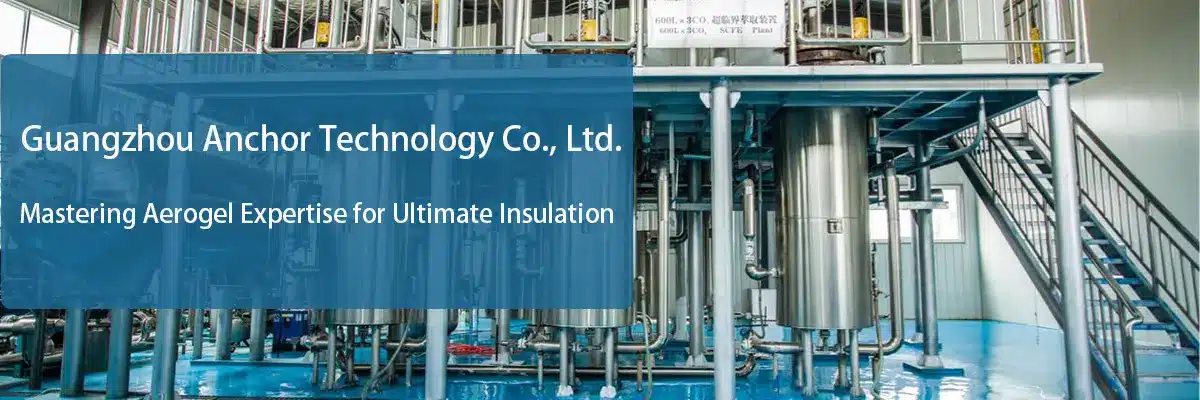
Anchor Aerogel produces AG90 at its own facility using sol-gel processing and supercritical drying, with batch control against the GB/T test methods listed in the specification table. We support industrial buyers through the full project cycle: qualification samples, cut-to-size supply against customer drawings, and technical input on pipeline, tank, and enclosure insulation layouts. Documentation can be aligned with the test standards referenced in your project specification. Parameters not published on this page, including dimensional tolerances and roll packaging, are confirmed in the current TDS or order documentation before shipment.
Engineering Boundaries & Custom Options
The standard AG90 range covers 3/6/10 mm thickness at 1500 mm width, with customization available for both. Performance boundaries are set by the 900°C maximum service temperature and the published conductivity values at 25°C and 300°C; any design point beyond the measured data requires engineering review rather than extrapolation. The blanket is hydrophobic, Class A2 non-combustible, and reusable, with a service life stated at over 15 years under correct conditions. It is not load-bearing and must be protected from oil, water, and organic solvents during storage, installation, and service.
Main Performance Parameters
No. | Item | Unit | Technical Specification | Test Standard |
|---|---|---|---|---|
1 | Max. Temp | ℃ | 900 | / |
2 | Density | g/cm3 | 0.15~0.21 | GB/T 34336-2017 |
3 | Thermal Conductivity (25°C) | W/(m·K) | ≤0.021 | GB/T 10295-2008 |
4 | Thermal Conductivity (300°C) | W/(m·K) | ≤0.072 | GB/T 10294-2008 |
5 | Fire Rating | / | Class A2 | GB 8624-2012 |
6 | Moisture Absorption | % | ≤5 | GB/T 5480-2017 |
7 | Vibration Mass Loss | % | ≤1 | GB/T 34336-2017 |
8 | Compression Recovery | % | ≥90 | GB/T 34336-2017 |
Precautions for Use
1.When installing the product, please wear a dust mask and rubber gloves.
2.During installation, keep the product clean and dry. Avoid contact with oil, water, or other organic solvents.
3.When cutting and fitting the product, ensure that the cutting tools are sharp to prevent cracking or delamination during the cutting process.
Sample Request FAQs
Quick answers about requesting and receiving free samples from Anchor-tech.
Can you provide samples?
Yes. Please share some basic information about your project with us — for example, where the material will be used and at what operating temperature. Rest assured this is only so we can help you choose the most suitable material, model, and specification. We will never disclose your project details to any third party.
Can we still request samples if we cannot disclose any project information?
No. If you are unwilling to share any information about your project, we are not obligated to support your R&D effort. Please respect the labor involved: preparing each sample requires a dedicated colleague and is quite time-consuming. Moreover, without knowing where and how you intend to use our product, we cannot even determine whether it is suitable for your application.
Are samples free, and how much can I request?
We provide 2 free samples of aerogel blanket, each sized 150 mm × 200 mm × T (or A4 size). If you need a larger quantity or many pieces, please let us know the reason — we are glad to support you. However, if you have never seen our sample before and only want to take a look, please do not casually request large amounts. A dedicated colleague must prepare every sample, which takes considerable effort. You may first take a look; once you confirm it is likely suitable for your project, you can request more from us.
Who pays for shipping?
Shipping costs must be borne by the customer. Please provide us with your FedEx account number and the recipient information (including name, address, phone number, postal code, etc.), and we will arrange the shipment for you.
How long does it take to prepare samples?
If the item is in stock, preparation generally takes 3–7 days. If it is out of stock and requires custom manufacturing, it takes 1–2 weeks. We will prepare your samples as quickly as possible.
Frequently Asked Questions about Special Fiberglass Aerogel Blanket (AG90)
Technical answers for overseas buyers, engineers, and project specifiers. For project-critical values, request the current TDS before final design.
AG90 is used for thermal insulation on petrochemical pipelines, district heating pipelines, storage tanks, armored vehicles, modular shelters, new energy battery systems, and energy-efficient buildings. Its glass-fiber-reinforced silica aerogel structure combines very low thermal conductivity with a maximum service temperature of 900°C, so it is typically selected where conventional mineral wool or calcium silicate would require several times the thickness. For critical duties involving thermal cycling, vibration, or outdoor exposure, provide your operating envelope so our engineers can confirm thickness and layering against the current TDS.
AG90 consists of silica aerogel integrated with a high-performance glass fiber mat, manufactured through sol-gel technology and supercritical drying. The inorganic glass fiber mat reinforces the inherently brittle aerogel phase, giving the composite adequate mechanical strength and processability while preserving the nanoporous structure responsible for its insulation performance. Published density is 0.15-0.21 g/cm3 (GB/T 34336-2017), compression recovery is at least 90%, and vibration mass loss is no more than 1%, which supports installation on piping and equipment subject to movement.
The published maximum service temperature is 900°C. Thermal conductivity is 0.021 W/(m·K) or less at 25°C (GB/T 10295-2008) and 0.072 W/(m·K) or less at 300°C (GB/T 10294-2008). Because conductivity rises with mean temperature, thickness selection for hot service should be based on the elevated-temperature value rather than the room-temperature figure. If your design point sits above 300°C, contact our engineering team for guidance and confirm all design inputs against the current TDS before finalizing heat-loss or surface-temperature calculations.
AG90 is produced in 3 mm, 6 mm, and 10 mm thicknesses with a standard width of 1500 mm; the specification table lists both thickness and width as customizable. This allows project orders to be matched to pipe OD, tank geometry, or enclosure panel sizes, and multi-layer installations can be built up where higher thermal resistance is required. Dimensional tolerances and roll lengths are not published on this page, so please confirm tolerance, length, and cutting allowance in the current TDS or your purchase specification before placing production orders.
Installers should wear a dust mask and rubber gloves, keep the blanket clean and dry, and avoid contact with oil, water, or other organic solvents. Cut with sharp tools to prevent cracking or delamination along the cut line. AG90 is an inorganic, low-organic-content material with a Class A2 fire rating (GB 8624-2012) and moisture absorption of 5% or less (GB/T 5480-2017), so it is inherently non-combustible and hydrophobic. It remains a non-structural insulation layer: outer jacketing, banding, and weather protection must be designed by the system engineer.
 English
  Chinese (China)
  Portuguese
  Spanish
  French
  Italian
  Turkish
  Vietnamese
  German
  Japanese
  Korean
  Hindi
Hindi  Arabic
  Polish
  Chinese (Taiwan)
  Malay
Malay  Thai
Thai  Finnish
  Dutch
Dutch  Swedish
  Slovenian