Flexible PET Cryogenic Aerogel Insulation Blanket-AG20
Product Description
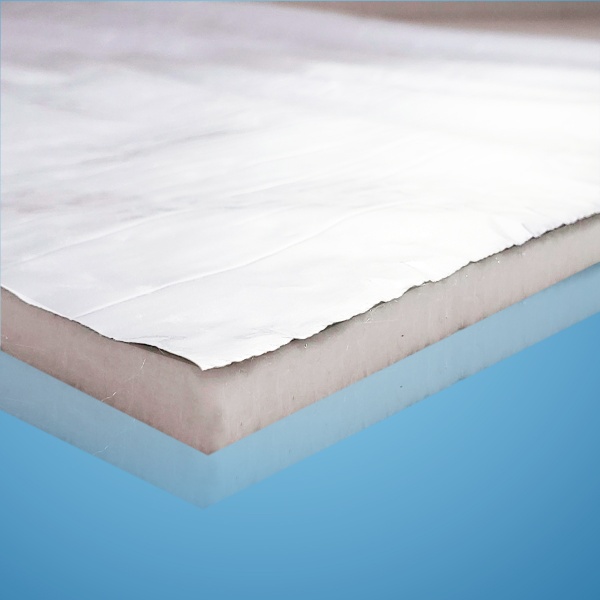
The AG20 PET Aerogel Blanket is a high-performance flexible insulation material developed specifically for cold insulation applications. It utilizes a blend of PET and glass fiber as the base substrate. Through a sol-gel process followed by supercritical extraction to remove solvents, aerogel particles are bonded to the substrate. This process ensures that the AG20 combines the flexibility of its fibrous base with the exceptional low thermal conductivity of aerogel.
This innovative material addresses several challenges associated with traditional insulation materials—such as polyurethane foam (PIR/PUR), rock wool, glass fiber, nitrile rubber, and olefin foam (LT+LTD)—which often require excessive thickness to achieve desired thermal performance, lose elasticity at low temperatures leading to potential breakage, suffer from aging resulting in reduced service life, and exhibit poor hydrophobic properties that can lead to corrosion due to water ingress. The AG20 PET Aerogel Blanket is ideal for applications in LNG pipelines, transport vessels, storage tanks, receiving stations, liquid nitrogen pipelines and storage tanks, liquid ethylene pipelines, and cold chain transportation for food and pharmaceuticals.
Product Specifications
Thickness | 5mm, 10mm or customized | Width | 1500mm |
Hydrophobicity | 99% | Applicable temperature | -200~125℃ |
Density | 160kg/m³ | Chloride ion content | 0.001% |
Thermal conductivity at 25 ℃ | 0.016~0.022W/(m·K) | ||
Typical Applications
- Liquid nitrogen storage and transportation;
- Low temperature/freezing pipes, equipment, containers, storage tanks, etc;
- Relevant devices of LNG Terminal;
- LNG carrier;
- Cold chain transport device
- Refrigerator, etc.
As industrial and technological advancements continue, the demand for effective cold insulation materials is increasing across various sectors. Below are some common applications and their corresponding cold insulation temperature requirements:
Application Area | Cold Insulation Temperature Range (°C) | LNG (Pipelines, Transport Vessels, Storage Tanks) | -162°C |
Liquid Nitrogen Pipelines, Storage Tanks | -196°C | Liquid Ethylene | -104°C |
Liquid Oxygen | -183°C | Liquid Hydrogen | -253°C |
Medical Field | -70°C to -80°C | Food Cold Chain Transport | -18°C to -30°C |
Comparison with Traditional Materials
Performance Indicator | PET Aerogel (AG20) | Polyurethane Foam | Rock Wool | Glass Fiber |
Thermal Conductivity (W/m·K) | 0.016–0.022 | 0.025–0.035 | 0.040–0.045 | 0.035–0.050 |
Density (kg/m³) | 150–200 | 30–60 | 80–120 | 100–150 |
Compressive Strength (MPa) | 0.5–1.0 | 0.2–0.5 | 0.1–0.3 | 0.3–0.7 |
Operating Temperature (℃) | -196 to 150 | -50 to 120 | -40 to 600 | -50 to 400 |
Service Life | 20 years | 8 years | 5 years | 10 years |
Comparison of Thermal Conductivity
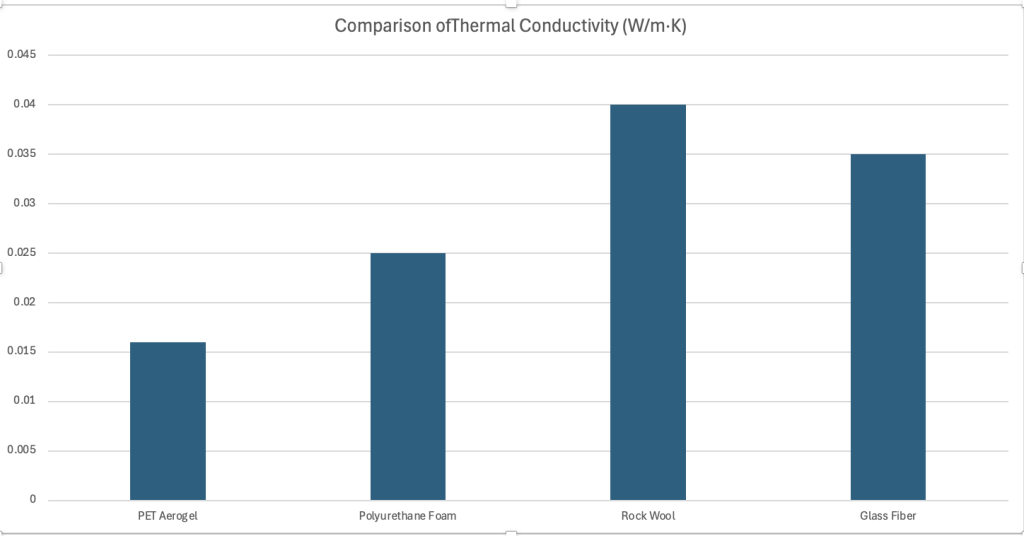
- The thermal conductivity of the AG20 PET Aerogel Blanket is 50% lower than that of traditional materials like glass fiber or rock wool. In our case studies, using the AG20 typically requires only 30% to 50% of the thickness of conventional insulation materials to achieve the same thermal performance.
- Testing has shown that at -150°C, the AG20 maintains a tensile strength greater than 0.52 MPa, has a water absorption rate of less than 3%, and exhibits a performance degradation of less than 5% after cyclic freezing.
Product Advantages
- High-efficiency insulation material for the cryogenic field: PET aerogel offers exceptional cold insulation performance, with thermal conductivity as low as 0.018–0.023 W/m·K. This significantly reduces the required insulation thickness by 30%–50% compared to traditional materials like rock wool or glass fiber, while still achieving the same level of insulation.
- Excellent low temperature stability: PET aerogel maintains excellent low-temperature performance, even at extreme conditions such as -196°C (liquid nitrogen). It remains flexible and does not fracture under deep cold conditions. It can withstand internal stress caused by pipeline expansion and contraction without the need for contraction joints, reducing the complexity of installation and minimizing potential maintenance issues.
- Excellent physical strength: The PET aerogel blanket has a compressive strength of 0.5–1.0 MPa, and with a service life of over 20 years, it can be reused after disassembly. This makes it highly practical for on-site inspection and repairs, significantly reducing downtime during maintenance operations.
- Hydrophobicity: The material is inherently hydrophobic, with a water absorption rate of less than 3%. This characteristic prevents corrosion caused by liquid water coming into contact with the surface of pipes and equipment, maintaining the integrity of the insulation and ensuring long-lasting performance even in humid or wet environments.
- Easy to install: PET aerogel is lightweight (150–200 kg/m³) and can be easily cut or sewn to fit pipes and equipment of various shapes. The flexibility in installation reduces the time and manpower needed for setup, improving efficiency in large-scale projects.
Manufacturer & Engineering Notes
Manufacturing & Project Experience
Anchor Aerogel developed AG20 specifically for cryogenic duty, bonding aerogel to a PET and glass fiber substrate through sol-gel processing and supercritical extraction. We support LNG, industrial gas, and cold chain projects with standard 5/10 mm rolls, customized thicknesses, qualification samples, and technical review of piping and tank insulation layouts against drawings. The comparison and low-temperature test data on this page, including tensile strength at -150°C and cyclic freezing results, come from our own testing; project-specific design values are confirmed in the current TDS or formal technical documentation before order acceptance.
Engineering Boundaries & Custom Options
Standard AG20 is a flexible blanket at 160 kg/m3 density, 5/10 mm thickness (customizable), 1500 mm width, 99% hydrophobicity, and conductivity of 0.016-0.022 W/(m·K) at 25°C. Performance boundaries: the specification table gives -200 to 125°C, while the comparison table cites -196 to 150°C; treat the current TDS as governing at the extremes. The blanket stays flexible in deep cold, needs no contraction joints, and is reusable after disassembly. Limitations: it is not load-bearing, compressive strength is 0.5-1.0 MPa, and vapor barrier and jacketing design remain the system engineer's responsibility.
Sample Request FAQs
Quick answers about requesting and receiving free samples from Anchor-tech.
Can you provide samples?
Yes. Please share some basic information about your project with us — for example, where the material will be used and at what operating temperature. Rest assured this is only so we can help you choose the most suitable material, model, and specification. We will never disclose your project details to any third party.
Can we still request samples if we cannot disclose any project information?
No. If you are unwilling to share any information about your project, we are not obligated to support your R&D effort. Please respect the labor involved: preparing each sample requires a dedicated colleague and is quite time-consuming. Moreover, without knowing where and how you intend to use our product, we cannot even determine whether it is suitable for your application.
Are samples free, and how much can I request?
We provide 2 free samples of aerogel blanket, each sized 150 mm × 200 mm × T (or A4 size). If you need a larger quantity or many pieces, please let us know the reason — we are glad to support you. However, if you have never seen our sample before and only want to take a look, please do not casually request large amounts. A dedicated colleague must prepare every sample, which takes considerable effort. You may first take a look; once you confirm it is likely suitable for your project, you can request more from us.
Who pays for shipping?
Shipping costs must be borne by the customer. Please provide us with your FedEx account number and the recipient information (including name, address, phone number, postal code, etc.), and we will arrange the shipment for you.
How long does it take to prepare samples?
If the item is in stock, preparation generally takes 3–7 days. If it is out of stock and requires custom manufacturing, it takes 1–2 weeks. We will prepare your samples as quickly as possible.
Frequently Asked Questions about PET Cryogenic Aerogel Blanket (AG20)
Technical answers for overseas buyers, engineers, and project specifiers. For project-critical values, request the current TDS before final design.
AG20 is developed for cold insulation on LNG pipelines, transport vessels, storage tanks, and receiving station equipment; liquid nitrogen pipelines and storage tanks; liquid ethylene pipelines; and cold chain transportation for food and pharmaceuticals, including refrigerators and cold chain transport devices. The page maps typical service temperatures: LNG at -162°C, liquid nitrogen at -196°C, liquid ethylene at -104°C, liquid oxygen at -183°C, and food cold chain at -18 to -30°C. The blanket remains flexible in deep cold and does not fracture under these conditions.
AG20 uses a blend of PET and glass fiber as the base substrate, with aerogel particles bonded to it through a sol-gel process followed by supercritical extraction. This combines the flexibility of the fibrous base with aerogel’s low thermal conductivity. Unlike polyurethane foam, rubber, or mineral wool, the blanket keeps its elasticity at low temperature, withstands internal stress from pipeline expansion and contraction without contraction joints, and resists aging. Testing cited on this page shows tensile strength above 0.52 MPa at -150°C and performance degradation below 5% after cyclic freezing.
The specification table lists an applicable temperature range of -200 to 125°C, a thermal conductivity at 25°C of 0.016-0.022 W/(m·K), density of 160 kg/m3, hydrophobicity of 99%, and chloride ion content of 0.001%. Standard thicknesses are 5 mm and 10 mm, or customized, at 1500 mm width. The comparison table on this page cites a wider operating window of -196 to 150°C; where your design approaches these bounds, confirm the governing value in the current TDS. Thickness typically runs 30-50% of conventional materials for equivalent insulation.
Per the comparison table on this page, AG20 delivers thermal conductivity of 0.016-0.022 W/(m·K) against 0.025-0.035 for polyurethane foam, 0.040-0.045 for rock wool, and 0.035-0.050 for glass fiber, with compressive strength of 0.5-1.0 MPa and a stated service life of 20 years versus 8, 5, and 10 years respectively. It addresses common failure modes of traditional materials: excessive thickness requirements, loss of elasticity and breakage at low temperature, aging, and poor hydrophobicity leading to water-ingress corrosion. Water absorption is below 3%.
AG20 is lightweight at 150-200 kg/m3 and can be easily cut or sewn to fit pipes and equipment of various shapes, reducing installation time and manpower on large-scale projects. Because it tolerates thermal contraction stress without contraction joints, installation is simpler and maintenance points are fewer. The blanket can be reused after disassembly, which is practical for on-site inspection and repair and reduces downtime. Its hydrophobicity and sub-3% water absorption protect against corrosion under insulation. Vapor sealing and jacketing details should still follow the project’s cryogenic insulation specification.
Application Examples (应用举例)
PET Cryogenic Aerogel Blanket (AG20) is specified wherever thickness is constrained and a dry, stable cryogenic insulation core is required. See how it performs in real applications:
- LNG storage & transport — Cryogenic tanks and trailers Aerogel Blankets for LNG Storage & Transport.
- Low-temperature pipelines (−20 °C to −200 °C) — End condensation and corrosion under insulation (CUI) Aerogel Blanket for Cryogenic Pipelines.
- Mobile cryogenic trailers — Recover payload volume with a thinner wrap Cryogenic & LNG Trailer Insulation.
Related low-temperature applications: aerogel insulation felt for cold chain · aerogel blanket for low-temperature pipelines
 English
  Chinese (China)
  Portuguese
  Spanish
  French
  Italian
  Turkish
  Vietnamese
  German
  Japanese
  Korean
  Hindi
Hindi  Arabic
  Polish
  Chinese (Taiwan)
  Malay
Malay  Thai
Thai  Finnish
  Dutch
Dutch  Swedish
  Slovenian