
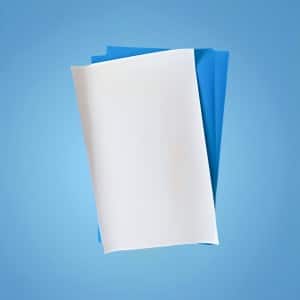
AGF-AGR Graphite Composite Aerogel Film | Ultra-Thin Insulation


Product Description
The AGF-AGR Graphite Composite Aerogel Film is a multilayer structure composed of an aerogel coating, a 20–50 μm synthetic graphite sheet, and a release liner. Standard total thickness ranges from 100 to 300 μm. Its innovation lies in combining two key functions: thermal insulation and heat spreading. The aerogel layer offers low thermal conductivity (0.022–0.026 W/m·K) to block external heat, while the synthetic graphite layer provides exceptional in-plane thermal conductivity (>150 W/m·K), rapidly dispersing internal heat sources. This synergy—acting as both a heat shield and a heat spreader—makes it ideal for complex thermal management in applications such as 5G RF units and advanced 3C electronics.
The graphite substrate adds flexibility and electromagnetic shielding properties. The release liner protects the graphite layer from contamination and enables easy peel-off during installation, exposing the clean surface for direct contact with heat-generating components. The aerogel layer is hydrophobic and resists moisture absorption and powdering, even in high-humidity environments. With a wide operating temperature range of -20°C to 220°C, AGF-AGR delivers reliable performance under demanding conditions in both consumer electronics and outdoor telecom equipment, meeting multi-dimensional heat management requirements.
Product Specifications
Product model | AGF-AGR | ||
Thickness(μm) | 50-400(customizable) | ||
Product Structure | Aerogel Coating + Graphite Sheet (20/30/50 μm) + Release Liner | ||
Standard Thickness (μm) | 100±10 | 200±20 | 300±20 |
Standard model | AGF-AGR-100 | AGF-AGR-200 | AGF-AGR-300 |
Thermal Conductivity (W/m·K) (Aerogel layer only) | 0.022~0.026 | ||
Temperature Resistance Range (°C) | -40~240 | ||
Continuous Operating Temperature (°C) | -20~220 | ||
Fire Resistance (UL94) | / | ||
Dielectric Strength (kV/mm) | / | ||
Volume Resistivity (Ω·cm) | ≥1.0×10¹³ | ||
Size | Supplied in rolls, customizable | ||
Storage conditions | Store in a dry, room-temperature environment. Shelf life: 3 years | ||
Comparison between different models
| Model | Structure Description | Standard Thickness (µm) | Substrate Thickness (µm) | Operating Temperature (°C) | Thermal Conductivity (W/m·K) | Abbreviation Notes |
| AGF–N | Pure aerogel coating | 500–3000 | – | -40 ~ 300 | 0.018–0.024 | AGF = Aerogel Film, N = No substrate |
| AGF–APA | Aerogel coating + PET film + Aerogel coating | 70, 140, 200, 250 | PET = 16 µm | -20 ~ 120 | 0.022 ~ 0.026 | A = Aerogel, P = PET |
| AGF–AGR | Aerogel coating + artificial graphite sheet + release film | 100, 200, 300 | Graphite sheet: 20, 30, 50 | -20 ~ 220 | 0.022 ~ 0.026 | G = Graphite, R = Release film |
| AGF–ACU | Aerogel coating + copper foil | 100, 200, 300 | Copper foil: 20, 30, 50 | -20 ~ 220 | 0.022 ~ 0.026 | CU = Copper foil |
| AGF–AAL | Aerogel coating + aluminum foil | 100, 200, 300 | Aluminum foil: 20, 30, 50 | -20 ~ 220 | 0.022 ~ 0.026 | AL = Aluminum foil |
| AGF–API | Aerogel coating + PI film | 100, 200, 300 | PI film: 25, 50 | -20 ~ 220 | 0.022 ~ 0.026 | PI = Polyimide film |
| AGF–AR | Aerogel coating + release film | 320, 400 | – | -20 ~ 220 | 0.03 | R = Release film |
| AGF–AP | Aerogel coating + PET film | 100, 200, 300 | PET = 1.9 µm | -20 ~ 120 | 0.022 ~ 0.026 | P = PET film |
| AGF–APR | Aerogel coating + PET film + release film | 50, 100, 200, 300 | PET = 1.9 µm | -20 ~ 120 | 0.022 ~ 0.026 | A = Aerogel, P = PET film, R = Release film |
| AGF–APDR | Aerogel coating + double side adhesive + release film | 50, 100, 200, 300 | Double side adhesive: 15 µm (PET 5 µm + adhesive 10 µm) | -20 ~ 220 | 0.022 ~ 0.026 | A = Aerogel, P = PET, D = Double Side Adhesive, R = Release film |
| AGF–PADR | PET film + aerogel coating + double side adhesive + release film | 50, 100, 200, 300 | PET = 1.9 µm, adhesive = 15 µm (PET 5 µm + adhesive 10 µm) | -20 ~ 220 | 0.022 ~ 0.026 | P = PET, A = Aerogel, D = Double Side Adhesive, R = Release film |
| AGF–TADR | TPU film + aerogel coating + double side adhesive + release film | 130, 230, 330 | – | -20 ~ 220 | 0.022 ~ 0.026 | T = TPU film, D = Double Side Adhesive, R = Release film |
Product Advantages
Efficient Heat Spreading: High-conductivity graphite layer ensures uniform temperature distribution.
Integrated Thermal Management: Sandwich structure combining aerogel, graphite, and release liner.
Wide Operating Temperature: Suitable for -20°C to 220°C, adaptable to various industrial applications.
Low Thermal Conductivity: 0.022–0.026 W/m·K for outstanding energy-saving performance.
Durable & Pressure-Resistant: Graphite sheet enhances structural strength and wear resistance.
Applications
Wearable Devices
Smartphones
Laptops
Tablets
OLED Displays
Smart TVs
Digital Cameras
Consumer Electronics
Manufacturer & Engineering Notes
Manufacturing & Project Experience
Anchor Aerogel builds AGF-AGR by combining its aerogel coating with synthetic graphite sheet and a protective release liner on its own lamination lines. We support overseas programs in 3C electronics and telecom equipment from specification review through sampling and repeat supply, and our engineers can help you select graphite gauge (20, 30, or 50 μm) and total thickness within 50-400 μm against your spreading and insulation targets. Roll or die-cut samples are prepared to your drawings for evaluation, with export packaging on all shipments. Current technical documentation, including the TDS, is available on request for supplier qualification and design validation.
Engineering Boundaries & Custom Options
AGF-AGR is the shield-plus-spreader option: its value is the combination of 0.022-0.026 W/(m·K) through-plane insulation from the aerogel and above 150 W/(m·K) in-plane spreading from the graphite, plus some EMI benefit. Orientation in the stack therefore matters - graphite toward the heat source, aerogel toward the protected zone in most layouts. Graphite is conductive, so no dielectric strength is published, and the sheet is less tolerant of sharp bending than polymer films. No UL94 rating is listed. Confirm electrical values in the current TDS and validate spreading performance at assembly level, since system results depend on contact quality.
Sample Request FAQs
Quick answers about requesting and receiving free samples from Anchor-tech.
Can you provide samples?
Yes. Please share some basic information about your project with us — for example, where the material will be used and at what operating temperature. Rest assured this is only so we can help you choose the most suitable material, model, and specification. We will never disclose your project details to any third party.
Can we still request samples if we cannot disclose any project information?
No. If you are unwilling to share any information about your project, we are not obligated to support your R&D effort. Please respect the labor involved: preparing each sample requires a dedicated colleague and is quite time-consuming. Moreover, without knowing where and how you intend to use our product, we cannot even determine whether it is suitable for your application.
Are samples free, and how much can I request?
We provide 2 free samples of aerogel film, each sized 150 mm × 200 mm × T (or A4 size). If you need a larger quantity or many pieces, please let us know the reason — we are glad to support you. However, if you have never seen our sample before and only want to take a look, please do not casually request large amounts. A dedicated colleague must prepare every sample, which takes considerable effort. You may first take a look; once you confirm it is likely suitable for your project, you can request more from us.
Who pays for shipping?
Shipping costs must be borne by the customer. Please provide us with your FedEx account number and the recipient information (including name, address, phone number, postal code, etc.), and we will arrange the shipment for you.
How long does it take to prepare samples?
If the item is in stock, preparation generally takes 3–7 days. If it is out of stock and requires custom manufacturing, it takes 1–2 weeks. We will prepare your samples as quickly as possible.
Frequently Asked Questions about AGF-AGR Graphite Aerogel Film
Technical answers for overseas buyers, engineers, and project specifiers. For project-critical values, request the current TDS before final design.
Category: ultra-thin aerogel insulation film – compare all AGF models.
AGF-AGR is a multilayer of aerogel coating, a 20, 30, or 50 μm synthetic graphite sheet, and a release liner, in standard total thicknesses of 100±10, 200±20, and 300±20 μm (customizable 50-400 μm). It combines two functions: the aerogel layer blocks external heat with a thermal conductivity of 0.022-0.026 W/(m·K), while the synthetic graphite spreads internal heat sources in-plane with conductivity above 150 W/(m·K). Acting as both heat shield and heat spreader, it addresses complex thermal management where insulation and spreading are needed simultaneously in one thin laminate.
The manufacturer highlights AGF-AGR for complex thermal management in 5G RF units and advanced 3C electronics, with listed applications spanning wearable devices, smartphones, laptops, tablets, OLED displays, smart TVs, digital cameras, and consumer electronics, plus outdoor telecom equipment. The graphite substrate adds flexibility and electromagnetic shielding properties, and the aerogel layer is hydrophobic, resisting moisture absorption and powdering even in high-humidity environments. This combination suits positions where a heat-generating component needs its hot spot spread out while adjacent temperature-sensitive parts are shielded – for example, between RF power components and displays or batteries.
The specification table lists a temperature resistance range of -40 to 240°C and a continuous operating temperature of -20 to 220°C for AGF-AGR, covering demanding conditions in both consumer electronics and outdoor telecom equipment. The hydrophobic aerogel layer maintains performance in humid environments without moisture-driven degradation or powdering, supporting reliability in outdoor deployments. As with other composites, sustained service near the upper limit should be validated on the actual assembly, since adhesives and liners in the final stack may impose tighter practical limits. Confirm the values applicable to your lot in the current TDS before design freeze.
The release liner protects the graphite layer from contamination and peels off cleanly during installation, exposing the clean surface for direct contact with heat-generating components. AGF-AGR is supplied in rolls with customizable size; total thickness can be tailored within 50-400 μm, and the graphite sheet can be specified at 20, 30, or 50 μm to set the spreading capacity. The laminate can be cut to shape for placement on components. Buyers can provide drawings so the factory can confirm tolerances and propose roll or die-cut formats; evaluation samples and project-aligned packaging can be arranged during the sampling stage.
Graphite is electrically conductive, so the published table lists no dielectric strength for AGF-AGR – keep the graphite face away from live contacts or add an insulating layer where isolation is needed. Synthetic graphite sheets are also brittle in bending compared with polymer films, so follow the factory’s handling guidance for tight radii and repeated flexing. Volume resistivity is published at ≥1.0×10¹³ Ω·cm as a typical value, and no UL94 flame rating is listed; confirm both in the current TDS. Store in a dry, room-temperature environment with a published shelf life of three years, keeping the liner on until installation.
 English
  Chinese (China)
  Portuguese
  Spanish
  French
  Italian
  Turkish
  Vietnamese
  German
  Japanese
  Korean
  Hindi
Hindi  Arabic
  Polish
  Chinese (Taiwan)
  Malay
Malay  Thai
Thai  Finnish
  Dutch
Dutch  Swedish
  Slovenian