
Aerogel Insulation for Modular Buildings and Prefabricated Facilities
Modular and prefabricated construction has moved well beyond temporary site offices. Today it encompasses worker accommodation camps, data-centre modules, cleanroom pods, offshore living quarters, medical and laboratory units, and rapid-deployment industrial facilities across global markets. For the engineers and project managers who design and procure these buildings, insulation is a recurring design constraint: module dimensions are fixed by road, sea, and ISO-container transport limits, so every millimetre of wall build-up trades directly against usable interior space.
Aerogel-based insulation offers a way to reach demanding thermal targets within thin wall, roof, and floor sections. Guangzhou Anchor Technology Co., Ltd. produces aerogel blankets, boards, ultra-thin films, coatings, and custom-shaped parts for industrial applications across a service temperature range of -200°C to 850°C. This article examines where these products fit in modular building envelopes and what buyers should verify before specifying them.
The Space Constraint in Prefabricated Construction
A transportable module is typically designed to the maximum legal shipping dimensions of its destination market. Once the structural frame and external cladding are fixed, the insulation layer competes with interior finish space, service voids, and MEP routing for the remaining depth. Conventional mineral wool or foam insulation can meet thermal requirements only by consuming several additional centimetres of section depth — depth that either enlarges the module (and breaches transport limits) or shrinks the interior.
Thin-profile, low-thermal-conductivity insulation changes this equation. Because aerogel materials deliver useful thermal resistance at substantially lower thickness than conventional fibrous or cellular insulations, designers can:
- Hold overall wall build-up within transport-constrained dimensions;
- Preserve interior floor area in accommodation and laboratory modules, where rentable or usable space is the commercial metric;
- Add thermal upgrades to existing module designs without re-engineering the frame.
Actual thermal performance for any build-up depends on the full assembly — framing thermal bridges, air sealing, and cladding — and should be calculated at system level rather than inferred from material conductivity alone.
Where Aerogel Products Fit in the Modular Envelope
Different product forms suit different layers of a prefabricated building:
- Aerogel boards and blankets integrate into wall, roof, and floor cassettes during factory assembly. Boards provide dimensional stability within framed cavities; flexible blankets wrap irregular services, curved surfaces, and areas where cutting tolerance is limited.
- Ultra-thin aerogel films serve in constrained build-ups: behind interior linings, within door and window reveals, around structural thermal bridges, and in refurbishment of existing modules where adding depth is not an option.
- Aerogel coatings can supplement sheet insulation on complex geometries — pipework, ducting, and plant skids housed inside or on top of modules — where wrapping is impractical.
- Custom-shaped parts support repeatable factory production: pre-formed insulation for standard module junctions, service penetrations, and HVAC connections reduces line labour and improves consistency across a production run of identical units.
Industrial and HVAC Applications Within Prefab Facilities
Many prefabricated facilities exist to house industrial processes, and their internal plant often needs insulation as much as the envelope does:
- HVAC ductwork and pipework. Compact module layouts leave little room for conventional duct lagging. Thin aerogel wraps help control heat loss, heat gain, and surface condensation within tight ceiling and riser voids.
- Process and utility lines. Modules containing hot water, steam-trace, or chilled services benefit from pipe insulation that fits within pre-allocated service corridors. Our products cover service temperatures from -200°C to 850°C, spanning both chilled and high-temperature duties.
- Condensation control. In humid climates or cold-chain-adjacent facilities, cold surfaces inside wall and ceiling voids are a mould and corrosion risk. Thin, hydrophobic insulation layers applied at the right locations can raise surface temperatures above dew point without redesigning the section.
For fire performance and code compliance, specifiers should request the manufacturer’s current documentation and confirm it against the building codes of the destination market — modular buildings frequently cross regulatory jurisdictions between factory and site.
B2B Sourcing Considerations
Procurement teams evaluating aerogel insulation for a modular building programme should work through the following:
- Design-stage engagement. Share wall, roof, and floor section drawings early. A supplier with fabrication capability can advise whether boards, blankets, films, or pre-formed parts best suit each junction, and flag tolerance issues before production.
- Data transparency. Request technical data sheets and clarify which values are typical versus guaranteed. Confirm cited test methods so figures compare fairly across candidate suppliers.
- Factory-friendly formats. Modular construction rewards repeatability. Ask about pre-cut kits, consistent thickness tolerances across lots, and packaging that survives factory handling and module transport.
- Samples and mock-ups. Before committing a production run, build a sample cassette or mock-up section with the proposed insulation to verify fit, fixing, and interface details with your framing system.
- Supply continuity. Multi-phase modular projects may reorder over months or years. Confirm the supplier’s production capacity, lot traceability, and lead times for repeat orders.
Guangzhou Anchor Technology works with modular builders and industrial project teams on product selection, samples, and custom fabrication. To discuss a specific prefabricated facility programme, contact our team.
FAQ
Can aerogel insulation meet building-code thermal requirements in thin modular walls?
Aerogel’s low thermal conductivity allows useful thermal resistance at reduced thickness, which suits transport-constrained sections. Whether a specific wall build-up meets a given code depends on the full assembly, including thermal bridging — this should be confirmed by your project engineer using the manufacturer’s current data.
Is aerogel insulation suitable for both hot and cold climates?
Yes. The same thin-profile insulation resists heat flow in both directions, and our product range covers service temperatures from -200°C to 850°C. Detailing — vapour control, air sealing, and fixing methods — should be adapted to the climate and code of the destination market.
Can you supply insulation pre-cut to our module drawings?
Yes. We supply custom-shaped and pre-cut aerogel parts to customer drawings, which supports repeatable factory assembly across identical modules. Contact us with your drawings and estimated volumes to discuss feasibility and lead times.
Aerogel for Building Insulation
Used for building insulation, aerogel reaches the required thermal resistance in a fraction of the thickness of mineral wool or foam. Modular and prefab walls meet the target without growing the transport envelope.
Related Articles & Applications

Industrial Equipment Aerogel Insulation: A Real Steam-Line Retrofit Case
Aerogel felt and coating for industrial equipment and pipeline insulation. Reduce energy loss and...
Read more →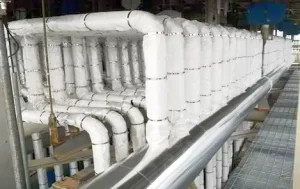
Aerogel for Industrial Pipeline Insulation: One-Third the Thickness, Same Performance
How aerogel insulation blankets cut heat loss and condensation on industrial pipelines. Thinner i...
Read more →
Aerogel Blankets for LNG Storage & Transport: Proven Cryogenic Performance
Aerogel felt for LNG tanks and cryogenic pipelines. Stable insulation from -200°C, hydrophobic an...
Read more →
Aerogel Powder & Slurry: Functional Fillers for Coatings and Composites
How aerogel powder and slurry are used in coatings, composites and insulation. Explore key applic...
Read more → English
  Chinese (China)
  Portuguese
  Spanish
  French
  Italian
  Turkish
  Vietnamese
  German
  Japanese
  Korean
  Hindi
Hindi  Arabic
  Polish
  Chinese (Taiwan)
  Malay
Malay  Thai
Thai  Finnish
  Dutch
Dutch  Swedish
  Slovenian